| ||||||||||
|
Thursday, February 28, 2019
What Is Slang? (And Should I Use It?)


Wednesday, February 27, 2019
Toward or Towards
|

QUESTION TAGS
| ||||||||||
|

Helpful Rhymes for Spelling Rules

Helpful Rhymes for Spelling Rules
In this post, we’re going to share some easy-to-remember rhymes that can help you with spelling. By following these easy rules, you can avoid some common mistakes (although it still pays to proofread, since there are always exceptions to spelling rules in English).
HyperGrammar2

HyperGrammar2 is a self-teaching tool designed to help you improve your knowledge of English grammar, spelling, punctuation, and capitalization.
Editing Spelling: American Standard English

Spelling
[The general content (below) was created in Canada; therefore, I have adjusted the specifics to adhere to American Standard English spelling. The general issue of consistent spelling is necessary for review to accomplish proper editing in all English-speaking areas: basically, make sure that you are spelling properly AND even if the term is spelled correctly, use the correct grammatical term within your sentence.]Tuesday, February 19, 2019
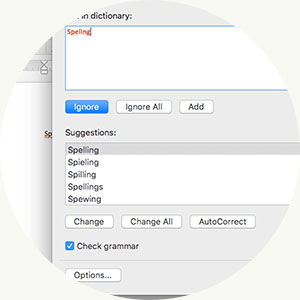
Why Spell Checkers Can Make Your WRITING Worse
|
Saturday, February 16, 2019
VERB TENSE: Remain Consistent
Verb Tense Consistency
Grammar Rules
Verb tense consistency refers to keeping the same tense throughout a clause. We don’t want to have one time-period being described in two different tenses. If you have two or more time periods, start a new clause or a new sentence.
Take this sentence with problematic tense consistency, for example:
Mark finished his essay, tidies his room, and went out for supper.
Sunday, February 10, 2019
Additional Help with Commas
Are you struggling with commas?
Once you memorize the basic rules for commas, your sentence content will flow better, your argument will be clearer, and your assignment scores will rise!
|
Additional help:
|
Saturday, February 9, 2019
How Do You Edit an Essay?
How
Do You Edit an Essay?
According to Elizabeth Lyons, "Some of the most effective editing involves tightening . .
.. SHORTEN a work
and it becomes better" (Nonfiction Book Proposals Anybody Can Write,
2000).

Updated
May 24, 2018
Proofreading Guide

A Guide to
Posted by The Ginger Team | October 25th 2011
Proofreading is an essential part of the writing process, no matter what type of document you are writing. Mistakes can include anything from misunderstanding English grammar, to spelling errors, usage of wrong words, and simply typos – but either way such
Once you are writing a text, you become very familiar with it. So familiar that your eye might easily skip over m1stak3s that you would otherwise recognize immediately. The most important tip for successful proofreading is to make yourself, or someone else, be able to read the text from a fresh point of view.
NEVER begin a sentence with a coordinating conjunction
You will NEVER
BEGIN a sentence
with a
coordinating conjunction

First, you will need to be able to recognize coordinating conjunctions when you see them.
And, but, for, nor, or, so, and yet—these are the seven coordinating conjunctions. To remember all seven, you might want to learn one of these acronyms: FANBOYS, YAFNOBS, or FONYBAS.
Friday, February 8, 2019
Idioms Become Monsters
When Idioms Become Monsters

Close but no cigar, fly off the handle, he is pulling your leg, I was beside myself—we see idioms like these all the time, even though the closer we look, the less sense many of them make.
Sometimes two familiar expressions get jumbled. When that happens, the result is what you might call a “Frankenstein formation,” a nod to the mad scientist who created a monster by conjoining parts that didn’t belong together.
Comma Usage in Dependent Clauses
What Is a Dependent Clause? (with Examples)
If you have been told that you are struggling properly punctuating sentences with dependent clauses, then HAVE NO FEAR! This page will provide you with general rules for punctuating sentences that contain dependent clauses, followed by examples of what dependent clauses actually are in English writing.
Use a comma after a dependent clause that starts a sentence.
Example: "When I went running, I saw a duck."
Example” “With the opioid crisis on the rise, Americans have no choice but to make changes.”
A dependent clause is a grammatical unit that contains both subject and verb but cannot stand on its own, like "When I went running ..." or “With the opioid crisis on the rise…”
An independent clause is a grammatical unit that contains both subject and verb and it can stand on its own. The independent clauses in the samples above would be:
"I saw a duck," and "Americans have no choice but to make changes."
Commas always follow these clauses at the start of a sentence. If a dependent clause ends the sentence, however, it no longer requires a comma. Only use a comma to separate a dependent clause at the end of a sentence for added emphasis, usually when negation occurs.
'It's' vs. 'Its'
| ||||||||||
|

Thursday, February 7, 2019
Commas Are EASY!!
Commas Are EASY!!
WHAT THIS HANDOUT IS ABOUT
This handout offers seven easy steps to becoming a comma superhero.
You can also visit this post about general comma rules written from a different perspective: HERE
You can also visit this post about general comma rules written from a different perspective: HERE
COMMAS, COMMAS, AND MORE COMMAS
Commas help your reader figure out which words go together in a sentence and which parts of your sentences are most important. Using commas incorrectly may confuse the reader, signal ignorance of writing rules, or indicate carelessness. Although using commas correctly may seem mysterious, it can be easy if you follow a few guidelines.
Rules For Using Commas
 |
13 Rules For Using Commas (Without Looking Like An Idiot)
Written by Christina Sterbenz
Sep. 17, 2013, 11:39 AM
Contrary to popular belief, commas don't just signify pauses in a sentence.
In fact, precise rules govern when to use this punctuation mark. When followed, they lay the groundwork for clear written communication.
We've compiled a list of all of the times when you need the mighty comma.
1. Use a comma before any coordinating conjunction (and, but, for, or, nor, so, yet) that links two independent clauses.
Example: "I went running, and I saw a duck."
You may need to learn a few grammatical terms to understand this one.
Subscribe to:
Posts (Atom)